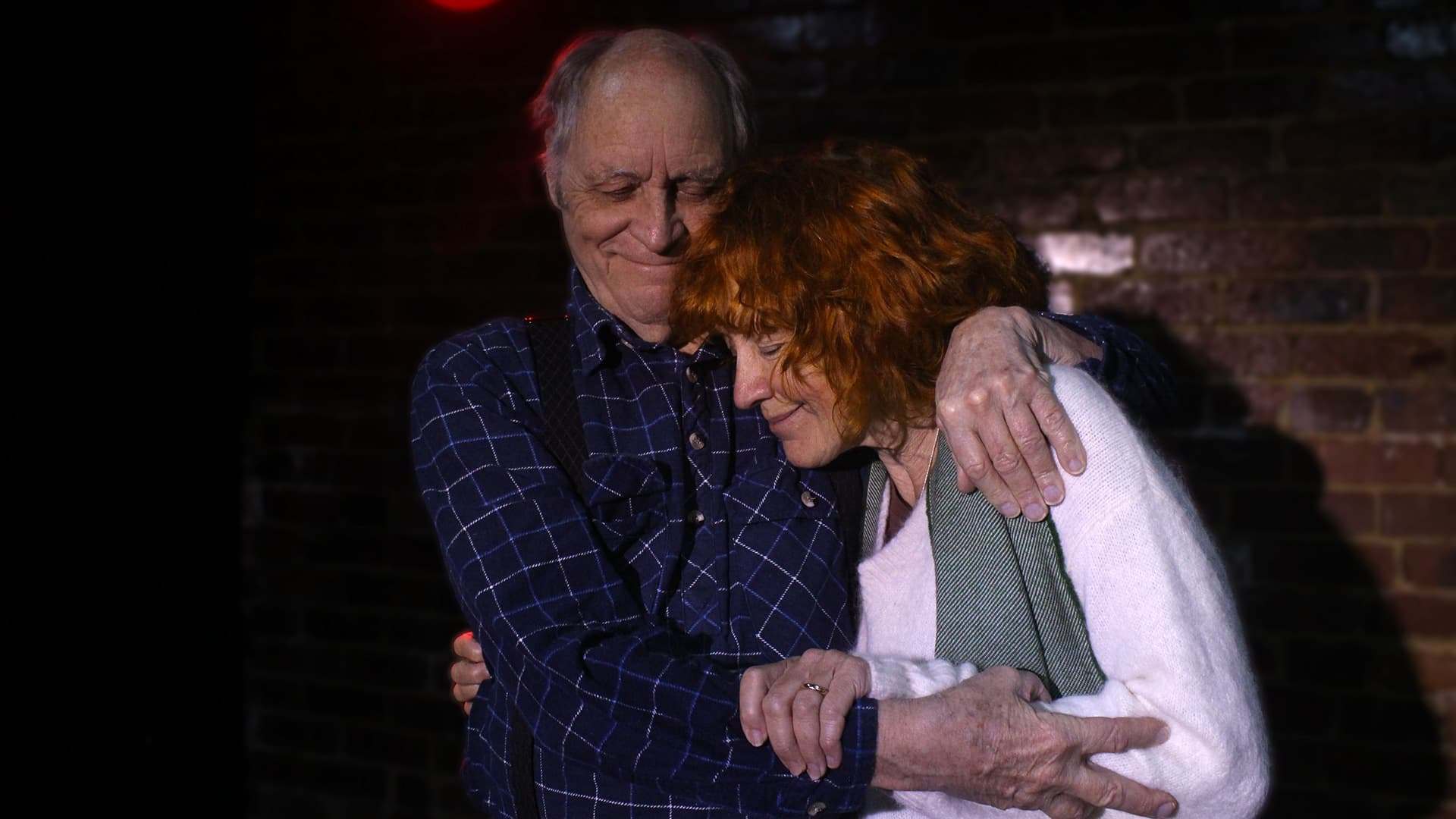

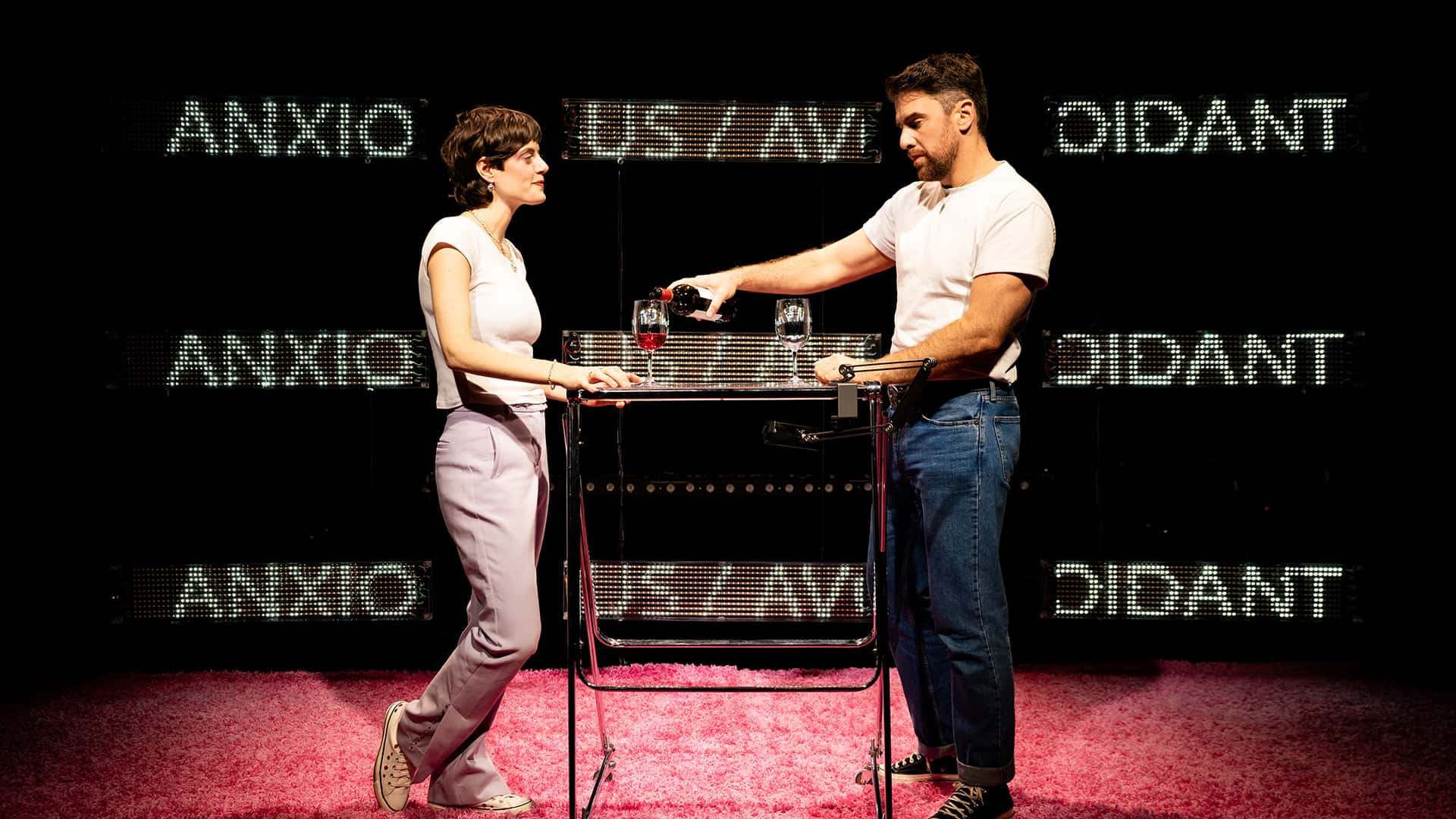
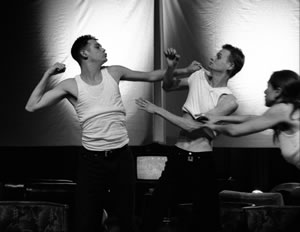
 Left - Oscar van Woensel, Gillis Biesheuvel and Sara De Roo. Cover - Oscar van Woensel, Gillis Biesheuveland and Kuno Bakker. Photos - Sanne Peper
Although rarely performed today, Titus Andronicus was one of Shakespeare’s earliest successes and from all accounts was wildly popular in its day. By far the bloodiest of Shakespeare’s plays, the level of onstage carnage in Titus Andronicus eclipses anything he subsequently wrote. Its hard to know exactly what the first audiences would have made of all the violence – whether Shakespeare meant it to be taken seriously or whether it was intended as an over the top romp, something akin to watching a Stephen King thriller or an episode of South Park, but we do know he never returned to such a relentless display of blood letting on stage.
The question of just how to handle the almost farcical level of violence makes it a problematic work for producers today. When it comes to a realistic representation of violence, live theatre is left for dead in the wake of modern cinema and the wonders of CGI, leading cultural critic Harold Bloom to declare he wouldn’t see another live production of Titus “unless Mel Brooks directed it.”
While early audiences loved Titus Andronicus, modern commentators have continued to argue over its worth. Bloom (a noted “Bardolator”) credits it with “no intrinsic value” and TS Eliot thought it “one of the stupidest and most uninspired plays ever written” – so much for public taste.
Fortunately critics don't run theatres and although Dood Paard’s adaptation of Titus, currently performing as part of the 2007 Melbourne International Arts Festival, is not quite the Mel Brooks musical Harold Bloom hopes for, it is nonetheless an entertaining and intriguing rendition.
This is the second entrant into this year’s festival by the Netherland’s based theatre collective - their first, medEia, a contemporary retelling of another classic tale, garnishing accolades for the experimental company. Like medEia, Titus makes use of a small cast playing numerous roles and although I didn’t see their first work, our reviewer’s advice to brush up on the storyline before attending could equally apply to Titus.
In this fast-paced production, the cast continually swap roles during the course of the play, and while that has the potential to make a complex story even more complicated, they actually do a pretty good job of keeping the audience abreast of who’s playing what at any point in time. Stage directions for the most part are spoken out loud, rather than enacted which saves us from endless scene changes and keeps the play moving at a tight pace. The set is a collection of second hand lounge chairs which clutter the stage, and upstage a curtain hangs a few feet off the ground, so that anyone behind it is revealed from the waist down. The actors are dressed casually, occasionally pulling on a wig or a different coloured shirt, retrieved from a mound of old clothes, to delineate between roles.
Dood Paard have stuck to the original story and while the language is largely Shakespeare’s, they have dispensed with the strict verse structure (a perceived barrier between the text and the audience), including some invention of their own. The use of pop music, a trademark of Dood Paard, seems quite random in Titus – at times the song selection bears little obvious connection to the stage action and at others, such as the use of the Wu Tang Clan rap, it is used brutally and to devastating effect.
The constant swapping of roles means the characters are disconnected from any individual performer, shifting the focus squarely onto the text to tell the story, rather than relying on the person or the personality of the actors to convey character. Text is absolutely central to Dood Paard’s performance style – in the program notes, Kuno Bakker explains “Everything the text does for you, you don’t have to do. You often do too much as an actor, but the moment you trust your text you can do less and less.”
Violence is represented almost perfunctorily, in much the same way as children playing in the school yard might perform it. A simple jab with an imaginary dagger is enough to kill off a character – cuffs dipped in red ink signify a missing hand (or two). No need for drawn out agonising death scenes, no need for dead bodies or severed limbs – we get the idea. For Dood Paard the spectacle of violence, is far less interesting than the consequence.
The production is infused with a dark humour, but that too is used as a means of distancing the audience from an emotional response. As with Brecht, the deliberate combination of alienation techniques forces us into a more cerebral or objective reaction to the work, limiting our emotional connection to the characters and emphasising the moral ambiguities of the play. As a result in this case, the dramatic arc is flattened, and the full emotional range of the play is consciously truncated.
This is an entertaining and clever work performed with much humour which belies its more serious philosophical base. And while I can say I genuinely enjoyed it, in honesty I found it much more interesting as a theatrical exercise than I did as a politically or emotionally engaging work.
Melbourne International Arts Festival presents
TITUS
Dood Paard
Venue: The CUB Malthouse, Workshop
When: Tue 23 – Sat 27 Oct at 8pm
Duration: 2hr no interval
Prices: Full $40 / Groups (8+) $36 / Conc $30 / Student $22 / School Groups $12
Bookings: Ticketmaster 1300 136 166 | www.melbournefestival.com.au